570
570
石斑魚是台灣重要的經濟魚類,但在養殖過程中,魚苗之間的殘食行為(cannibalism)往往是導致存活率低的重要原因。過去研究發現,點帶石斑魚(Epinephelus coioides)與鞍帶石斑魚(俗稱龍膽,E. lanceolatus)的殘食模式相似,當攻擊者的體長約為獵物的1.3 倍時,即可順利吞食。然而,研究人員在觀察棕點石斑魚 (俗稱虎斑,E. fuscoguttatus)時,發現它的殘食行為與前兩者大不相同,經常發生殘食失敗,導致雙亡的情況,這引起了科學家的興趣。
石斑魚苗在體長約 13–16 mm 時開始發生殘食,通常會從獵物的頭部咬住,然後水平吞入。然而,這個過程能否成功,關鍵在於攻擊者的嘴寬(MW)是否大於獵物的體高(BD)。如果嘴巴不夠大,獵物就無法完整吞入,可能會導致兩條魚同歸於盡。
研究發現,虎斑的嘴巴相對於體型較小,而體高卻發育得較快。當虎斑試圖吞食比自己小的魚苗時,經常因為嘴巴張不開而卡住,形成「兩敗俱傷」的悲劇。根據數據分析,虎斑的攻擊者體長必須達到獵物的1.44–1.52 倍才能成功吞食,遠高於點帶石斑與龍膽石斑的 1.3 倍門檻,這證實了虎斑的「小嘴問題」。
總結來說,虎斑因為嘴巴發育較慢,導致吞食困難,這與其他石斑魚不同。這一發現不僅幫助我們了解石斑魚的行為,也提供了改善養殖管理的新思路,未來若能針對不同魚種制定更精細的管理策略,將有助於提升石斑魚苗的存活率,促進養殖產業的發展。
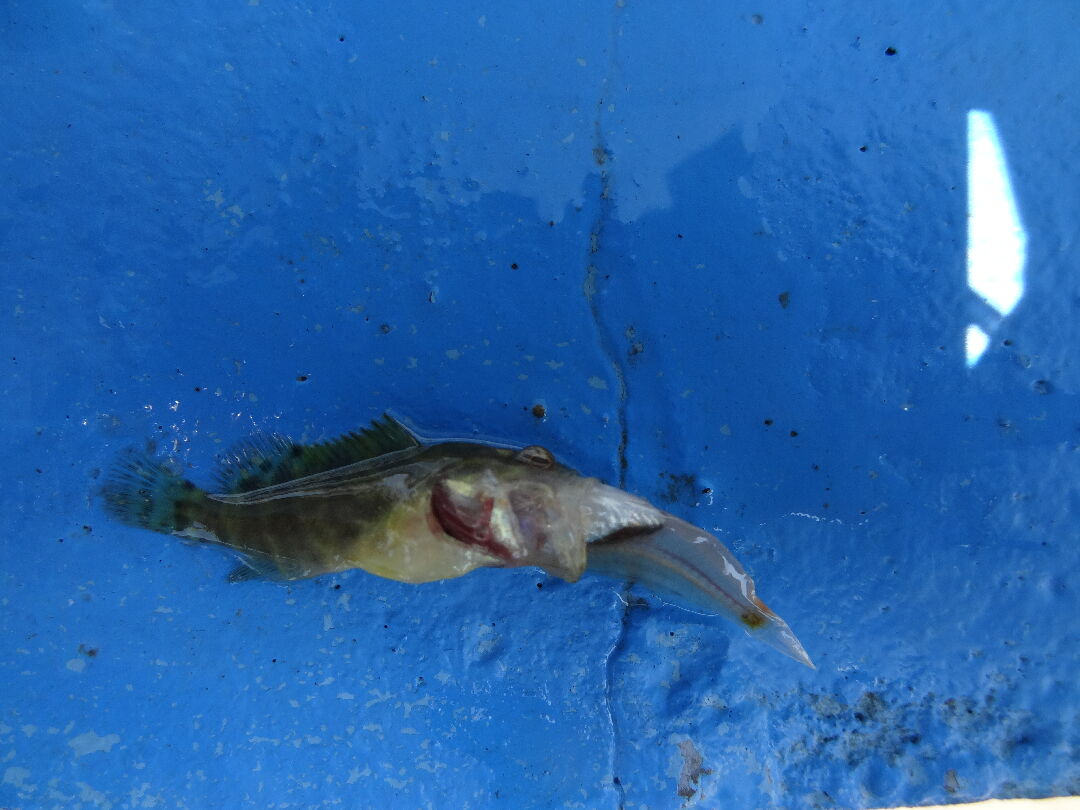
圖. 殘食失敗造成捕食者與被捕食者雙雙死亡的情形
Groupers are among the most economically important fish species in Taiwan. However, during aquaculture, cannibalism among juveniles is a major cause of low survival rates. Previous studies have shown that orange-spotted grouper (Epinephelus coioides) and giant grouper (E. lanceolatus) exhibit similar cannibalistic patterns: a predator can successfully swallow its prey when its body length is about 1.3 times larger.
Interestingly, researchers observed a very different pattern in the brown-marbled grouper (E. fuscoguttatus). Cannibalistic attempts in this species often fail, frequently resulting in the death of both individuals. This unusual outcome has attracted scientific attention.
Cannibalism in grouper juveniles typically begins at a body length of about 13–16 mm. The predator usually attacks the prey from the head and attempts to swallow it horizontally. Whether this process succeeds depends largely on the relationship between the predator’s mouth width (MW) and the prey’s body depth (BD). If the mouth is not wide enough, the prey cannot be fully ingested, which may lead to fatal consequences for both fish.
In E. fuscoguttatus, the mouth is relatively small compared to body size, while body depth develops rapidly. As a result, when individuals attempt to consume smaller conspecifics, they often fail because their mouths cannot open wide enough, causing the prey to become lodged. This leads to a “mutual mortality” scenario.
Data analysis shows that a predator of this species must be approximately 1.44–1.52 times larger than its prey to successfully swallow it—significantly higher than the 1.3 threshold observed in other grouper species. This finding confirms the so-called “small mouth constraint” in E. fuscoguttatus.
In summary, the relatively slower development of mouth size in this species limits its ability to successfully ingest prey, distinguishing it from other groupers. This insight not only improves our understanding of grouper behavior but also provides practical guidance for aquaculture management. Developing species-specific rearing strategies may help increase juvenile survival rates and support the sustainable growth of the grouper farming industry.
附件
 1 則留言
1 則留言